72 s in standard mode
Plan with roughly 72 seconds per measurement point in the regular Eco workflow.


Product
Core Points
For teams that want to use local material data internally without starting immediately with maximum automation and mapping depth.
Plan with roughly 72 seconds per measurement point in the regular Eco workflow.
When variants need to be compared quickly, a mode from roughly 20 seconds per point is possible.
Eco brings local material data into the laboratory without requiring a large automation project.
If required, optical 3D information from test indentation and topography can be added.
Details
i3D® WLI Eco for compact local material data
Short standard time, compact platform, optional 3D measurement and a clean entry into local material data. That is exactly what Eco stands for.
Software
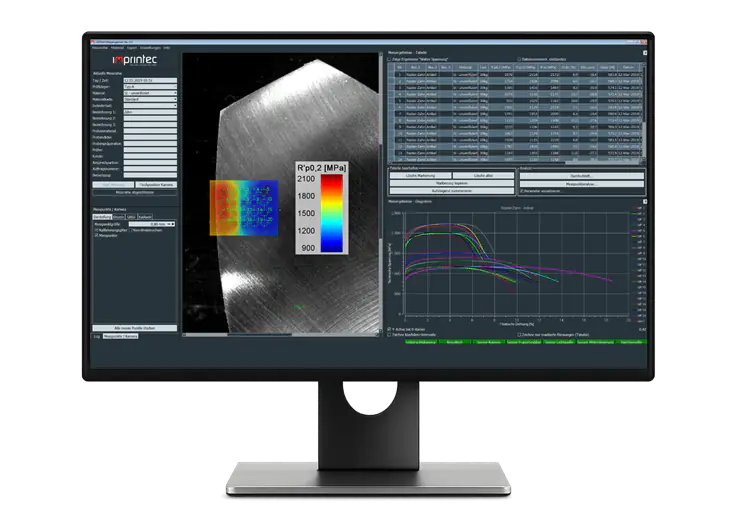
The compact entry changes nothing about the actual evaluation: inverse FEM, local yield strength Rᶦₚ₀,₂, tensile strength Rᶦₘ and stress-strain curves run in the same digital workflow.
WLI Eco is strong when local material data should become available internally and the setup deliberately needs to stay compact.
Eco is therefore not a small Pro substitute, but the right entry if local material data should become available internally and scaling is planned for a second step.
Eco is currently offered as a new device. WLI, superspeed and software packages are added according to the workflow instead of being overloaded by default.
That keeps the entry economical without giving up the methodological value of i3D®.
Contacts
If sample, part or laboratory target is roughly clear, it can be checked quickly whether Eco is technically sufficient.

Applications – Materials Testing
Application support, materials testing and technical customer guidance.
LinkedInRelated Systems
That makes it clearer whether Eco is sufficient or whether Pro, mBV, BVR or Inline is the better system logic.