Step 1
Create the indentation
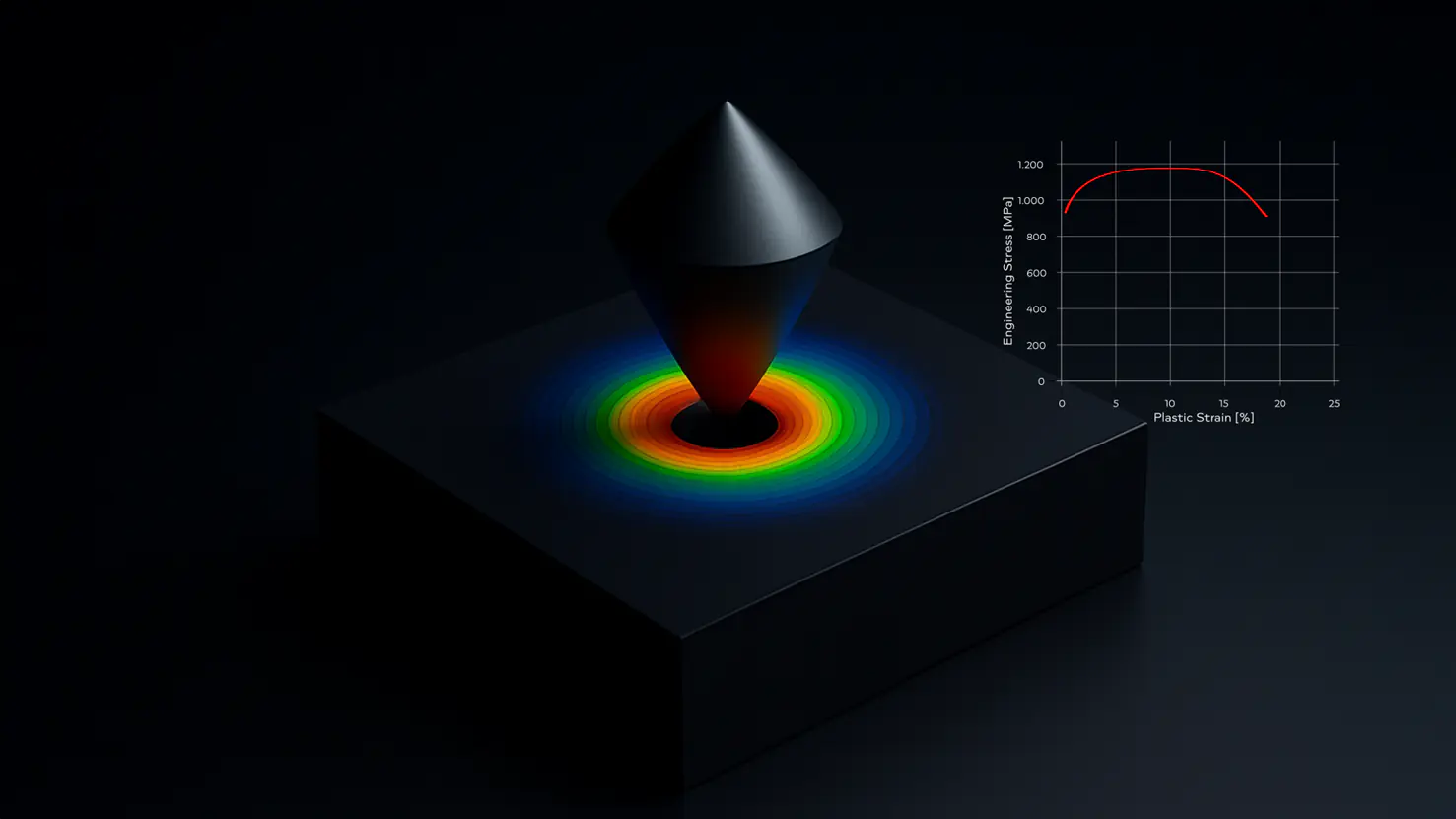
A force-controlled indenter moves orthogonally into the metallic surface. That creates the local and minimally invasive starting point for the later property evaluation.
i3D® Technology
Test workflow
The process logic moves in four steps from the local surface to the plastic stress-strain curve: indentation, 3D measurement, inverse FEM and the derived material properties.
Step 1
A force-controlled indenter moves orthogonally into the metallic surface. That creates the local and minimally invasive starting point for the later property evaluation.
Step 2
White light interferometry captures the indentation with high vertical and lateral resolution. That records not just depth, but the real geometry of the tested zone.
Step 3
An optimisation algorithm compares the real indentation shape with FEM simulations. From that, the local material response is reconstructed model-based and translated into an evaluable stress-strain relationship.
Step 4
The calculated stress-strain curve provides the local yield strength, tensile strength and other mechanical properties. That turns the indentation into a directly usable data set for development, QA and material assessment.
Technology value
The technology matters when local material properties are not just measured, but used as a robust basis for engineering decisions.
Rᶦₚ₀.₂ can be determined locally wherever the real zone is more relevant mechanically than the global average of an idealised specimen.
Rᶦₘ becomes accessible on part zones, small specimens, welds and critical areas, without first extracting a classical tensile specimen from the same zone.
Together with the inverse evaluation, the indentation can be used to derive plastic stress-strain relationships that are suitable for material assessment and model building.
The indentation, optical 3D capture and inverse FEM together form a traceable technological workflow instead of just a single isolated number.
Method classification
In short: Rᶦₚ₀.₂ and Rᶦₘ are closely comparable. Elongation at break and hardening need tighter interpretation.
Data depth
The i3D® evaluation does not stop at the indentation image. The indentation geometry, optical measurement and inverse evaluation are used to determine local stress-strain relationships. From these, yield strength Rᶦₚ₀.₂, tensile strength Rᶦₘ and the course of plastic hardening can be derived for the tested zone.
Scientifically, the relevance does not come from the stress-strain curve shape alone, but from the derivation of robust local properties from small or critical material zones.
That is exactly where the method addresses questions around Rᶦₚ₀.₂, Rᶦₘ and local stress-strain curves, while classical tensile testing is often too large, too expensive or geometrically unsuitable.
i3D® combines the indentation, optical 3D capture and model-based evaluation in one continuous workflow according to DIN SPEC 4864. The value does not lie in one isolated feature, but in the controlled coupling of these steps.
That turns the local indentation into an evaluable data basis for Rᶦₚ₀.₂, Rᶦₘ and further mechanical relationships, without having to reproduce the full classical specimen route in every case.
A good run starts before the evaluation. What matters is a clean task definition, the right zone and reproducible boundary conditions.
If measurement location, material state and target property match, the indentation becomes a technically usable decision basis rather than an isolated number.
i3D® does not replace every other method in every context. Its strength lies where local material insight, part proximity and time savings are especially important.
That is why the technology page also needs a clean classification: what is meaningfully comparable to tensile testing and classical material characterisation, where the limits are and when an additional validation step makes sense.
Positioning
The decision sits on local relevance, part proximity and the limits around elongation at break and hardening. That is what determines whether i3D® fits technically.
Contacts
Useful when zone, target properties, comparison path or feasibility need to be clarified directly with a technical contact.
Founder and CEO
Contact for the technology itself, the method classification and strategic i3D® use concepts.
LinkedIn
Applications and materials testing
Contact for materials testing, application questions and the technical classification of real measurement tasks.
LinkedIn