
Indentation Plastometry: Multisample Screening
Additive Manufacturing: Mechanical Characerization of Laser Powder Bed Fusion Samples
Abstract: Multisample screening or high-throughput testing with Imprint Test supports the development of alloys by quick determination of material data, especially in the field of additive manufacturing. In this study, 12 samples with a total number of 62 plastic stress-strain curves were automatically characterized within one hour. The samples (2 ScalmalloyⓇ [AlMgScZrMn] variants) were printed as cubes and the measuring surface has been grinded with 800 grit. Furthermore, for the same print job the determined material properties from the Imprint Test were compared with corresponding tensile tests. The Imprint Test achieves a cost reduction of 70 to 90% compared to tensile testing for these measurements."Hence, the Imprint Test offers many new opportunities for fast (high-throughput) development as well as other quality assurance applications. The demonstrated approach for additively (LPBF) manufactured parts and materials is only one of those possibilities where it can be deployed successfully." [ Frank Palm | Central Research & Technology | AIRBUS ]
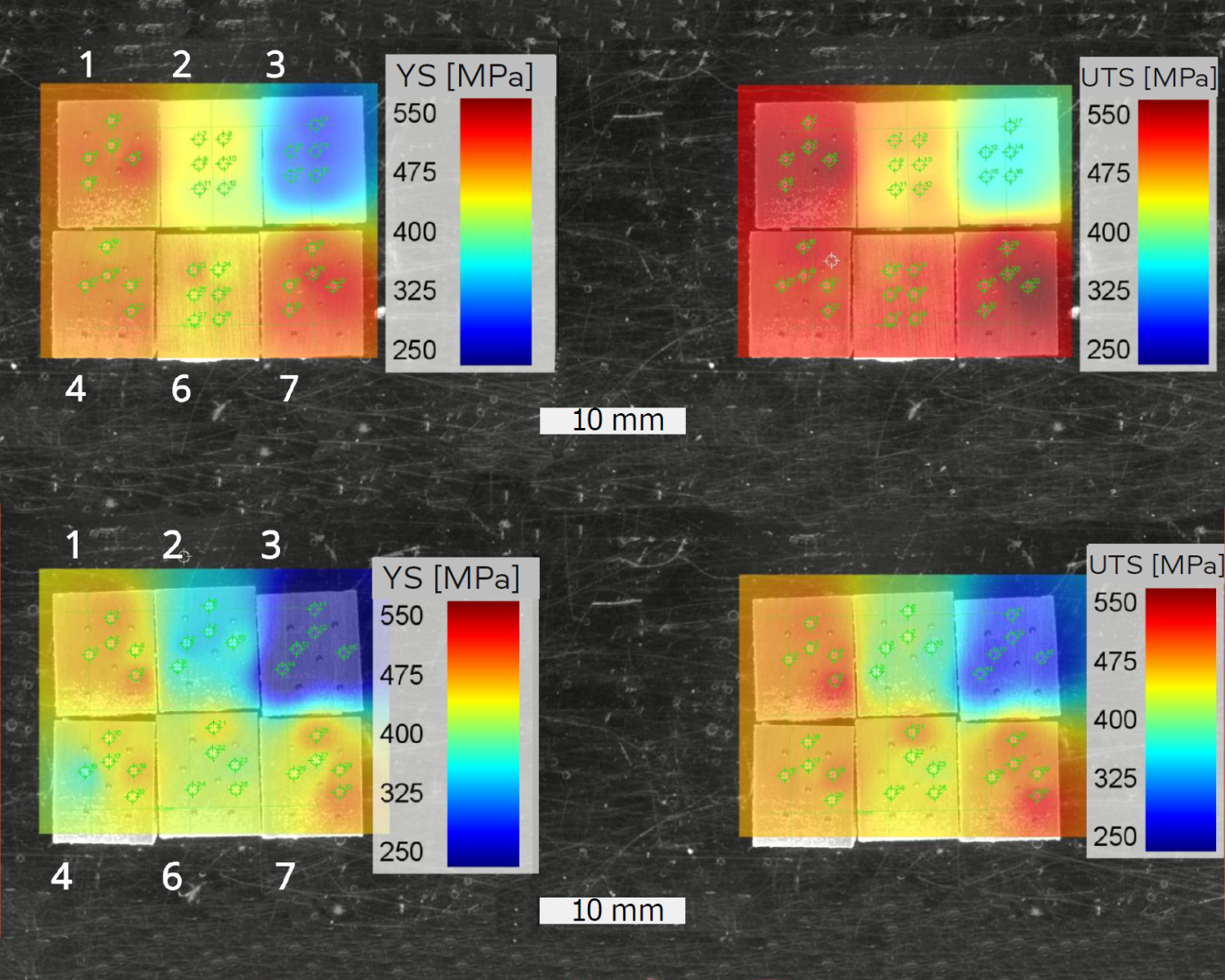 Fig. 1: Heat map of mechanical properties (yield strength and tensile strength) from the Imprint Test on 12 samples (ScalmalloyⓇ)
However, some inherent challenges for “3D printed” materials come from the complex interaction of the solidification microstructure with the final mechanical properties. These properties are determined by a selected post-manufacturing (LPBF) heat treatment. Unfortunately, such a material microstructure tailoring (to minimize residual stresses [due to solidification], optimize strength and ductility [precipitation hardening]) is challenging due to the LPBF process dynamics causing irregularities, imperfections (originating from the highly dynamic melting peculiarities, solidification rates, and boundary conditions). Aluminium alloys are susceptible to 3D-printing build defects such as solidification porosities (gas and shrinkage), fusion defects (bonding) due to oxide contamination and other microstructural inhomogeneities.
LPBF is a complex multi-parameter process that has to be accompanied by fast and reliable high throughput testing methods so as to find the “sweet spot” for manufacturing high-performance parts as well as assure the part integrity (absence of major defects in the 3D printed part). Standardized material evaluation with respect to strength and ductility and also in general from a quality assurance perspective is time-consuming and expensive. Traditional hardness tests like Brinell or Vickers have proven to be versatile with respect to global material strength, however, they lack providing reliable answers regarding the material’s plasticity. It is also known from many tensile tests that elongation at fracture and necking are very sensitive to undesired LPBF build defects and correct or incorrect post LPBF heat treatments. Here, a technical extension of an established indentation test like Brinell with a force-controlled procedure, 3D image analysis combined with a hybrid-AI based algorithm (Imprint Test) can disclose new options to asses material properties (strength and ductility) quickly and accurately.
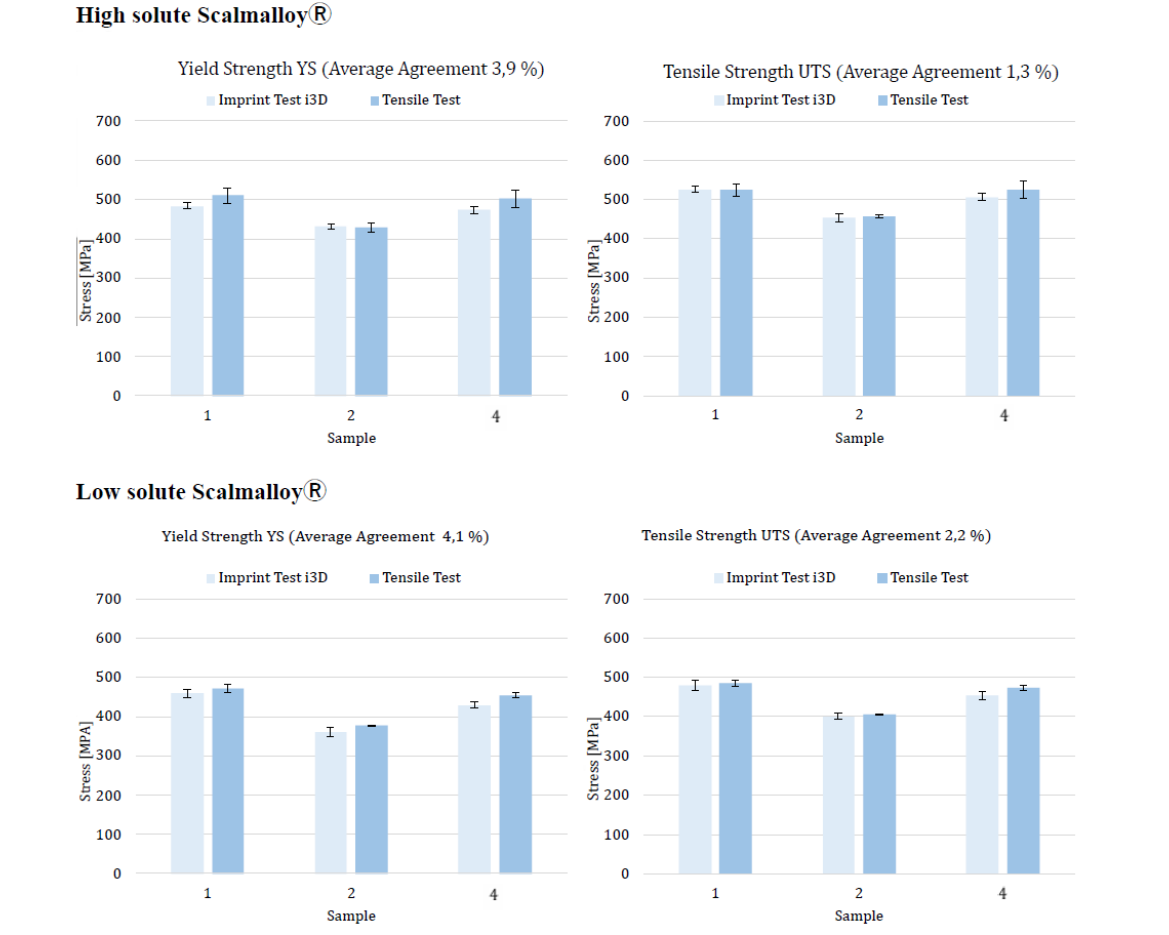 Fig. 2: Comparison between Imprint Test and tensile testing results on yield strength and tensile strength on samples 1,2 & 4 from 2 ScalmalloyⓇ variants.
A study was conducted with 2 LPBF-generated ScalmalloyⓇ (AlMgSZrMn) variants which was tested in different post-LPBF temper conditions. The high Sc content of the alloy remains almost completely in solid solution after 3D printing so that a precipitation hardening heat treatment taking the specific metallurgy of Al-Sc into account is possible. Depending on the temper conditions a diffusion-driven Sc decomposing is affecting a remarkable strength increase originating from Sc-enriched nano-sized cluster (1 - 2 nm) which culminates in an ordered ~ 4 - 6 nm sized, fully coherent intermetallic L12 - phase (Al3Sc(Zr)). At this peak-aged temper, the yield strength of the ScalmalloyⓇ material is more than double compared to the “as printed” (soft) alloy while retaining good ductility. The mechanical properties evaluated using standardized tensile testing vs Imprint Test were compared and found to be successful (see Fig 1). Slight discrepancies were observed in the measured values for elongation at fracture from the tensile and predicted values from the Imprint Test. On further evaluation, it was found that the tensile tests also showed a wide scatter in measured elongation at fracture. These scatter or deviations in the results can be mainly attributed to imperfections in the build material due to unstable LPBF process parameters. Such differences are instantly visible as fluctuations in the elongation at fracture on evaluated plastic stress-strain curves from the Imprint Test, thereby accurately reproducing the scatter. Furthermore, the determined stress-strain curves evaluated from the Imprint Test trials on separate heat-treated test cubes fit quite well (within sufficient material sensitivity) to the real tensile test results (see Fig.2).
Contact Us
If you have any questions regarding the verification of your materials, please feel free to contact us.
You can reach us also as follows:
Phone: +49 234 970 414 04
Email: info@imprintec.de